
Working together to protect our environment Community pest plant control
Pest plant control is a team effort between Horizons, partner agencies and landowners across the region. Find information about our control programmes, read about the collaborative work that's been done so far, and download some handy resources here.

The task of pest plant management is much greater than can be dealt with by Horizons alone. The future of biosecurity in our region relies on joint efforts with our community and other agencies to manage the impacts of pest plants on our environment and economy.
Field horsetail programme
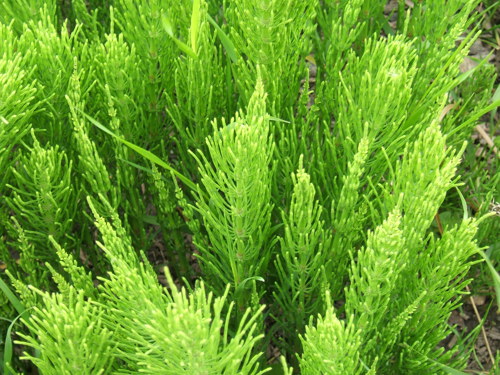
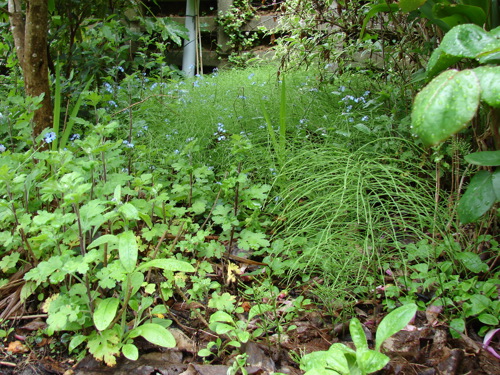
Field horsetail (Equisetum arvense), has become a serious invasive pest of pasture, crop and riparian areas in our region. Traditional weed control measures are costly, minimally effective and are struggling to control or even reduce the spread of this weed.
In late 2017 a bioagent, the horsetail weevil Grypus equiseti, was released in the Rangitīkei District near Bulls to help control the invasive weed. The release was managed by the Rangitīkei Horsetail Group with Horizons, NZ Landcare Trust and Landcare Research.
Current progress
Weevils were initially deployed at six different sites, with monitoring ongoing to measure their success. Two of these sites have shown areas where the weevil has eaten into the stem and subsequently laid its eggs. These eggs become larvae and migrate down the stem feeding on it at the same time, consuming and breaking up the roots.
This success comes after an 8-year project led by the Rangitīkei Horsetail Group who endorsed scientists to carry out research which led to the selection of the weevil. The weevil became an ideal candidate for biocontrol as it only ate field horsetail and did not migrate to any native plants.
While the first stage of the project is now completed there is still more work to do to ensure successful continued survival and natural breeding continues to occur. The weevils move only a few kilometres per year so this long-term project will focus on the control of field horsetail rather than eradication. Hopefully in the future we will have a nursery of weevils to increase mass deployment.
Since the deployment, the weevils have been found to have successfully established at a site in Whanganui, with ongoing monitoring to assess their success.
|
|
Preventing freshwater pest invasions
Our region has been forged by rivers, and along with our lakes they are sources of food and enjoyment for many of us. Freshwater pests can significantly impact not only our enjoyment of these spaces, but damage the biodiversity and natural ecosystems that make them so special.
By checking for freshwater pests, cleaning your gear, and drying it thoroughly, you’re helping protect our waterways. Unfortunately, we have several of these pests already causing problems in our region. By following the simple 'Check, Clean, Dry' steps you can help stop the spread of pests such as hornwort, invasive gold clams, and koi carp in the North Island.
|
Invasive gold clam - image credit NIWA. |

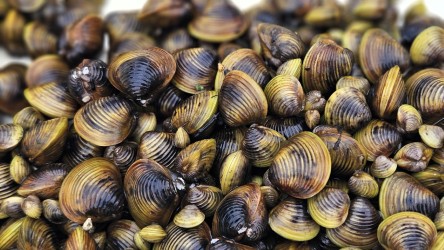
In 2023, the invasive freshwater gold clam (Corbicula fluminea) was discovered on the Waikato River at Lake Karapiro, prompting a national biosecurity response from Biosecurity New Zealand. While adult clams are clearly visible to the naked eye, juveniles clams are far smaller and not easily visible, presenting a potentially undetectable threat. The clam was also discovered in Lake Rotomanu in New Plymouth in 2025.
We ask that freshwater users upskill themselves in the updated Check, Clean, Dry method to make sure their gear is clean between waterways to help prevent the spread of clams.
For more information about what Horizons is doing with the Check, Clean, Dry programme, get in touch with us here.
Check out below what our ambassador Didymo Dave has to say about protecting our region's freshwater spaces.
Tutsan control
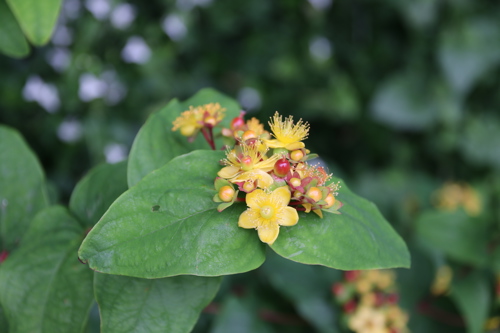
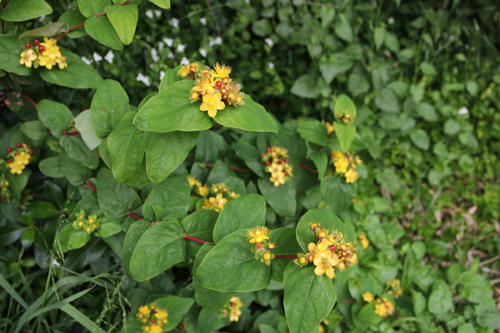
Tutsan (Hypericum androsaemum) is a semi-evergreen shrub growing up to 1.5m tall with stalkless oval leaves opposite each other up to 100mm in length. If left to spread, it forms dense stands which prevent the establishment of native plant seedlings. It thrives in habitats with shorter vegetation, making it a particular nuisance on paddocks.
The Tutsan Action Group was formed in Taumarunui in 2007 by Horizons, the Department of Conservation, a local farm consultant and farmers concerned about increasing spread of tutsan in the Ruapehu District. The group was formed to identify best practice techniques to control tutsan, pathway management and the investigation of potential biocontrol candidates. A ute guide was created that synthesised the findings of the group and can be downloaded below. Two biocontrol agents were identified as potential candidates – the tutsan moth and the tutsan beetle – with both being released in the region in 2017. Both agents are yet to show signs of establishment with staff continuing to monitor sites on an annual basis.
|
|
Purple loosestrife management
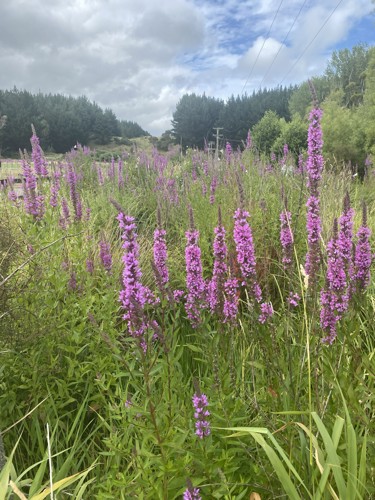
Purple loosestrife (Lythrum salicaria) is an invasive pest plant that grows along stream banks, lake edges and drains. It displaces native species and constricts waterways which can lead to flooding and loss of recreational use. The plant is present in the region, primarily in the Horowhenua District where it has firmly established infestations along the edges of Punahau Lake Horowhenua and down the Hokio Stream to the coast.
With the inability to use traditional methods for effective control of these infestations, Horizons looked to biocontrol to help manage them. We’ve worked closely with Muaūpoko Tribal Authority and Lake Horowhenua Trustees to produce an integrated pest management plan, which looks to reduce the abundance of purple loosestrife in established areas and eliminate outlying populations.
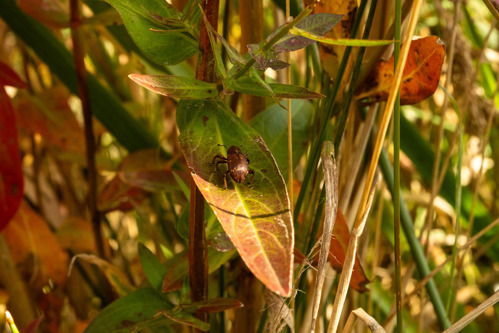
In 2025, four insects were approved by the Environmental Protection Agency for release in New Zealand, including two leaf beetles, a root weevil, and a flower weevil. In April 2026, the first round of root weevil (Hylobius transversovittatus) and one of the leaf feeding beetle (Galerucella pusilla) species were released around Punahau. Further releases of the root weevil and leaf beetles are planned for the 26/27 growing season.
|
|
Tackling Phragmites karka
Phragmites karka is an aggressive, fast-growing, extremely damaging pest plant.
Often confused for bamboo, Phragmites karka can grows up to 4m tall (though has been found to grow to 10-plus metres tall with support from nearby trees), with large, tightly clustered shoots which don’t allow other plants to grow. Phragmites karka is very difficult to control, as all parts of the plant can potentially regrow and form new colonies. The large underground rhizome system helps the plant to regrow even after cutting and spraying. Phragmites karka can grow in wide range of soil types, including in waterways. It is even known to grow through hard materials such as concrete, tar seal, and floor boards.
Horizons Regional Council contributed funds to Awahuri Kitchener Park Trust through the Kanorau Koiora Taketake Community Biodiversity Grant to support investigative work into control methods for Phragmites karka. In a collaborative effort between contractor Aaron Madden, Green by Nature, and an operational team from Ngāti Kauwhata Mana Taiao, a variety of methods have been trialled on Phragmites karka infestations at Awahuri Kitchener Park to identify what could control the plant. As the plant is incredibility difficult to kill, trials helped rule out a number of options as either ineffective or too expensive to be a practical solution. Through the trials, the team have discovered that Phragmites karka responds to different control methods in different ways, depending on the growth stage of the plant. Positive progress has been made so far, with significant Phragmites karka populations in the park having reduced in size and vigour, and some young plants eradicated entirely. Trials are ongoing as of 2026.