
Mahi tahi me te tangata whenua Working together with tangata whenua
Our region is home to more than 30 iwi and 100 hapū. Strong relationships between Horizons Regional Council and tangata whenua aren't just good practice, they're essential to good environmental decision-making in a region where the connections between people and place run deep.

Statutory context
Regional councils have statutory obligations to facilitate and support tangata whenua participation in resource management processes. These obligations are not discretionary – they are set by Parliament and sit alongside councils’ other legal duties.
Several pieces of legislation create specific duties. These include:
Note: This list is subject to updates to reflect law reform processes and new legislation.
Strengthening partnerships with tangata whenua
Te Tiriti o Waitangi/the Treaty of Waitangi is a symbol of the enduring partnership between Māori and the Crown. As an agent of the Crown, Council is a Treaty partner with many obligations to fulfil.
To help us meet these obligations, we've adopted Te whakakaha whanaungatanga ki te tangata whenua | Strengthening partnerships with tangata whenua as one of the four strategic priorities in our Long-term Plan. We're committed to fostering mutually beneficial partnerships, enabling participation, protecting Māori interests and values, supporting capacity and capability building, and encouraging early and meaningful engagement.
In addition to these commitments, one of our six community outcomes is:
He whanaungatanga whai mana | Our region's relationships with iwi and hapū are respectful and mana-enhancing
As the whakataukī says:
Nāku te rourou nāu te rourou ka ora ai te iwi.
We achieve more together than alone. An enduring, productive relationship between Horizons, tangata whenua and the resource users of our region will always produce better outcomes than any of us working separately.
Our mahi tahi framework
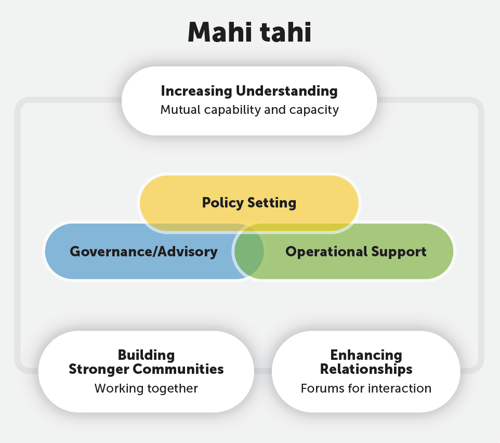
The current mahi tahi between Council and the iwi and hapū of the region falls into roughly three categories; policy setting, governance and/or advisory roles, and operational input. Council and iwi/hapū contribute to this mahi in many different ways.
As the diagram illustrates below, through this mahi tahi we increase mutual understanding, enhance the relationship between Council and tangata whenua, and we build stronger communities.

Māori Advisory Team
Our Te Pae Kōuka advisors are the primary point of contact between Horizons and the tangata whenua of our region. They support partnership structures, develop and maintain formal relationship agreements, build organisational cultural competency, and enable meaningful tangata whenua engagement in policy development, resource management and environmental projects.

Formal Partnerships and Arrangements
Iwi and hapū throughout the region have expressed a desire to work in various forms of partnership with Horizons. Some of these aspirations are embedded through Treaty settlements – others are acknowledged through memoranda of partnership and other formal arrangements.

Iwi and Hapū Environmental Management Plans
An Environmental Management Plan is a document prepared by an iwi or hapū authority that sets out how that group wants their taonga, rohe and cultural values considered in resource management and planning decisions.

Treaty Settlements
When an iwi settles with the Crown, the resulting legislation includes provisions that create direct obligations for regional councils. Our region is one of the last in the country where the settlement process is still actively underway. For us, that means both ongoing obligations and new opportunities to work alongside iwi and hapū as they realise their aspirations.

Statutory Acknowledgements
Statutory acknowledgements are statements of cultural, spiritual, historic, and traditional associations of an iwi with a site or an area acknowledged by the Crown in Treaty of Waitangi settlement processes. They have legal weight from inclusion in Treaty claims settlement acts.

Iwi and Hapū Contacts
Horizons maintains an iwi and hapū contacts database for the region. This database ensures that our staff are communicating and facilitating connections with the right people.